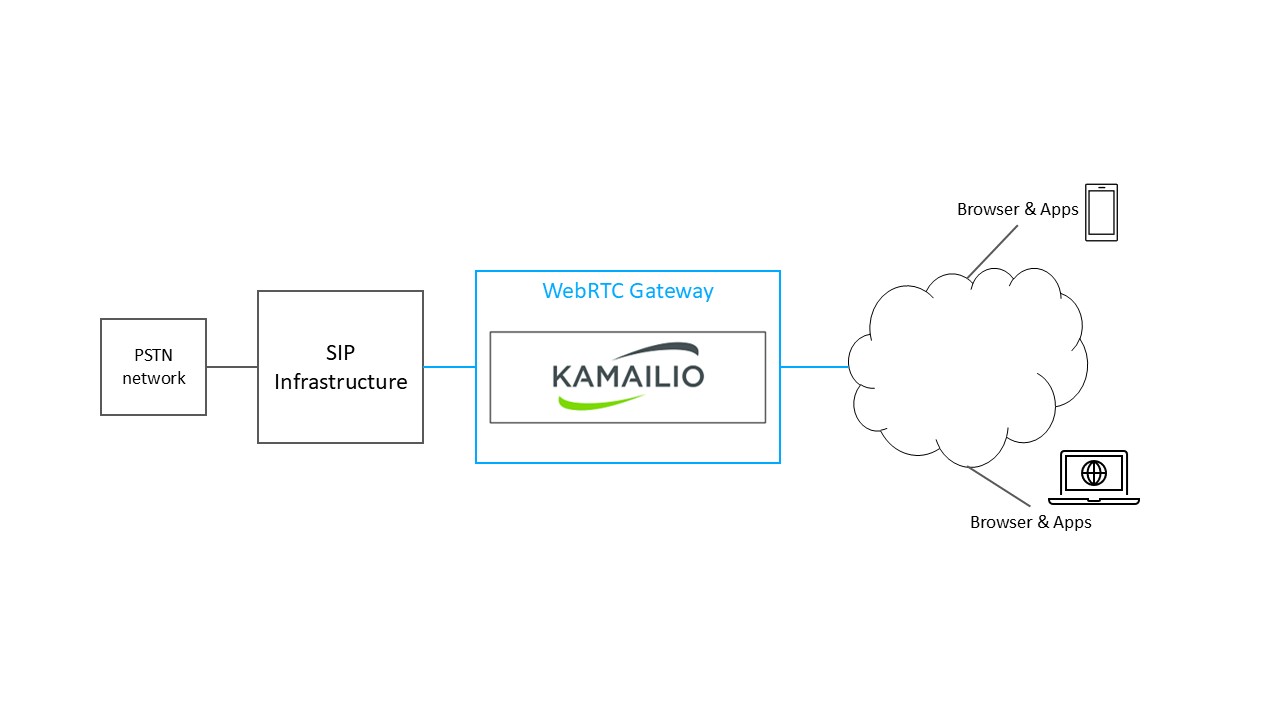
WebRTC Gateway
Our WebRTC Gateway is an add-on product that brings browser- and app-based voice and video calling to your existing VoIP infrastructure, without replacing it.
It registers directly to your existing SIP server as a standard SIP endpoint, bridging WebRTC clients to your telephony landscape transparently.
Calls made from a web browser or mobile app reach your existing users, extensions, and PSTN connections just like any other SIP call.

WebRTC Gateway Platform
Overview of the GILAWA WebRTC Gateway, a Kamailio-based add-on that integrates seamlessly into your existing SIP landscape.
- WebRTC-to-SIP signalling bridge based on a proven stable Kamailio version
- Media transcoding and relay via RTPEngine — handles codec negotiation between WebRTC and SIP endpoints
- Secure WebSocket (WSS) transport for browser and app clients
- Registers to your existing SIP-server with your existing account, provides Caching and better performance, while no change to your current infrastructure needed
- Support for voice and video telephony from browser or native app
- TLS certificate provisioning via Let's Encrypt for secure signalling
- Common codec support including OPUS (WebRTC), G.711, G.722, and VP8/VP9 for video
- Local firewall and fail2ban configuration included
- Delivery includes: deployment on one server, functional test verification, interconnection test with your SIP server
- Optional additional services
- TURN/STUN server setup for NAT traversal in restrictive network environments
- REST API interface for provisioning and call control
- Failover and high-availability configuration
- Integration with your web or mobile application (SDK guidance)
- Maintenance contract and updates
System requirements
- Virtual machine at least 2 vCPUs, 4 GB RAM, 20 GB disk
- Operating system Linux Debian 12, Debian 13, Ubuntu 22.04 or 24.04
- One public IPv4 network address with forward DNS configured
- Existing SIP server reachable from the gateway (SIP trunk or registration credentials)
- One E-Mail address for certificates and system messages
- SSH root access for installation and test support
- Docker or Kubernetes deployment available as part of a project